
Hanuman Ji, the beloved devotee of Lord Rama, is often remembered for His heroic deeds in the Ramayana — burning Lanka, carrying the Sanjeevani mountain, and serving Shri Ram with unmatched devotion. But very few people know that Hanuman Ji also appears in the Mahabharata and plays a crucial role in guiding the Pandavas. His connection with Bhima, one of the five Pandava brothers, is a fascinating episode that highlights Hanuman Ji’s compassion, strength, and divine purpose.
This story not only reveals the relationship between two brothers born of Vayu Dev (the wind god) but also teaches profound lessons about humility, devotion, and the eternal presence of Hanuman Ji in Sanatan Dharma.
Hanuman Ji in the Ramayana vs. Mahabharata
When we think of Hanuman Ji, our mind immediately goes to the Ramayana. His devotion to Shri Ram, immense strength, and wisdom are celebrated in countless bhajans, temples, and festivals.
However, the Mahabharata also carries a few episodes where Hanuman Ji appears — especially in connection with Bhima and later during the Kurukshetra war. While the Ramayana portrays Hanuman Ji’s service to Lord Rama, the Mahabharata highlights His role as a guide and protector of Dharma.
Bhima and Hanuman Ji: The Brothers Born of Vayu
Both Hanuman Ji and Bhima share a divine origin.
- Hanuman Ji was born to Anjana Devi and Kesari, but He is considered the son of Vayu Dev, as it was the wind god who blessed His birth.
- Similarly, Bhima was born to Kunti through the blessings of Vayu Dev.
This makes Hanuman Ji and Bhima spiritual brothers. Both were blessed with incredible physical strength, speed, and courage. But their personalities were different:
- Bhima was proud, impulsive, and sometimes arrogant about his strength.
- Hanuman Ji, on the other hand, was humble, wise, and used His powers only in service of Lord Rama.
It is this difference that set the stage for their legendary meeting in the Mahabharata.
The Meeting of Bhima and Hanuman Ji
During the Pandavas’ exile in the forest, Draupadi once requested Bhima to bring her the sweet Saugandhika flower, which was said to grow in Kubera’s gardens in the Himalayas. Bhima, always eager to show off his strength, set out on this journey.
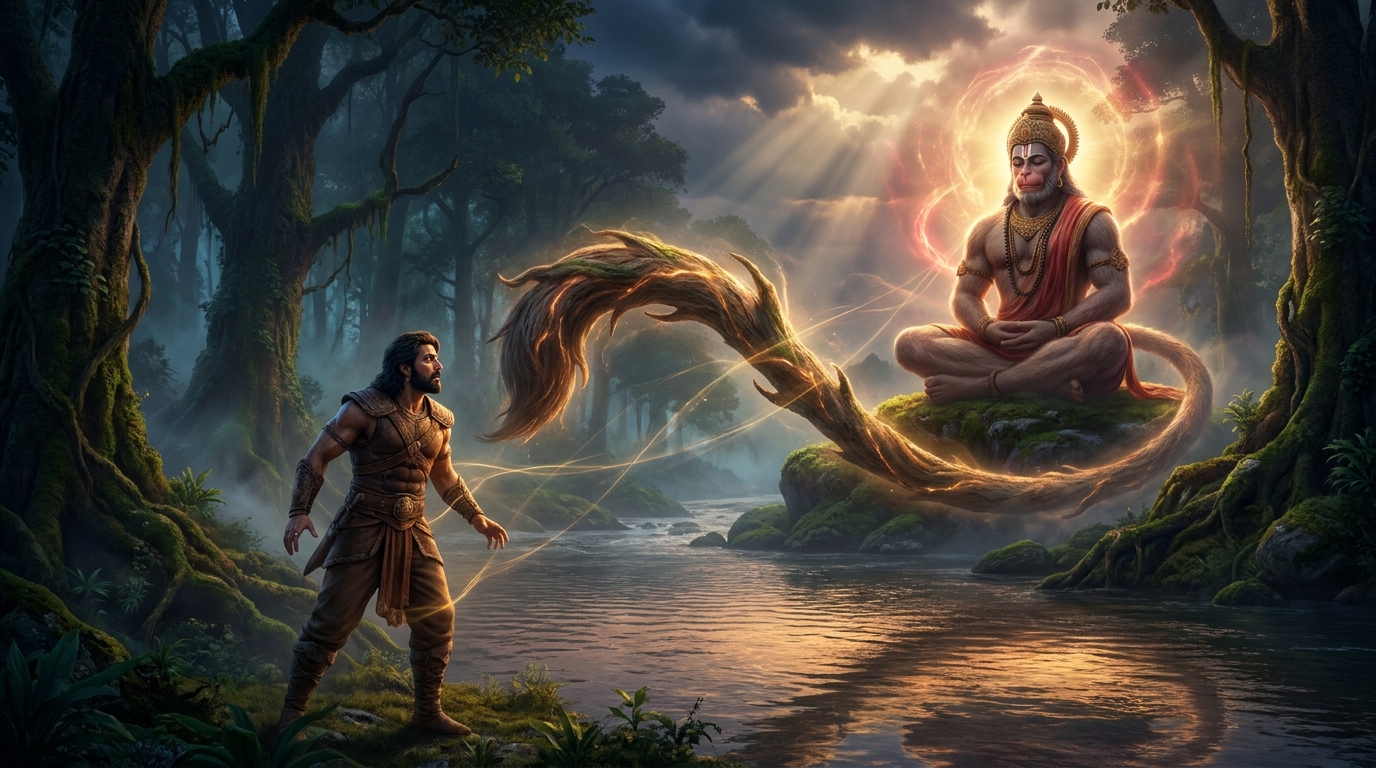
As he marched through the dense forest, crushing trees and scaring animals with his powerful steps, he came across a huge old monkey lying across his path. The monkey’s tail was stretched out, blocking the way.
Bhima shouted, “Move aside, old monkey! I have urgent work and cannot waste time.”
The monkey, who was none other than Hanuman Ji in disguise, softly replied, “I am old and weak. Please lift my tail and move it yourself.”
Bhima, irritated, tried to push the tail aside with his mace, but it did not move. Surprised, he used both hands, applying all his strength, yet the tail remained unmoved.
Confused and humbled, Bhima realized that this was no ordinary monkey. Folding his hands, he asked, “Who are you, O mighty one? None in this world can resist my strength. Surely, you must be divine.”
At that moment, Hanuman Ji revealed His true form — vast, radiant, and awe-inspiring. Bhima bowed in reverence, realizing that he was standing before his elder brother, the great Hanuman Ji.
The Lessons Hanuman Ji Taught Bhima
This meeting was not just a casual encounter but a divine arrangement to teach Bhima important lessons.
1. The Importance of Humility
Bhima was immensely proud of his strength. By failing to move Hanuman Ji’s tail, he learned that no matter how strong one is, there is always someone greater. Hanuman Ji reminded him that true strength lies in humility and service, not arrogance.
2. Service to Dharma Is the Highest Duty
Hanuman Ji explained that His strength was always dedicated to the service of Shri Ram and the protection of Dharma. He advised Bhima to use his powers not for pride or anger but for the greater cause of righteousness.
3. The Eternal Presence of Hanuman Ji
Hanuman Ji blessed Bhima, saying, “Whenever the name of Shri Ram is chanted, I will be present. In the coming war of Dharma at Kurukshetra, I will also be there to protect the Pandavas.”
Hanuman Ji’s Blessing for Arjuna’s Chariot
Hanuman Ji’s role did not end with Bhima. He extended His blessings to Arjuna, Bhima’s brother, before the Kurukshetra war.
When Arjuna prepared for battle, Lord Krishna suggested he place a divine symbol on his chariot for protection. Arjuna prayed to Hanuman Ji, who agreed to sit on the flag (dhwaja) of his chariot.
Thus, Arjuna’s chariot bore the Kapi Dhwaja (flag with Hanuman Ji).
Symbolism of Hanuman on Arjuna’s Flag
- His presence infused courage and fearlessness in Arjuna.
- Hanuman Ji’s mighty roar shook the hearts of enemies.
- It symbolized that victory comes when strength is combined with devotion and humility.
Hanuman Ji and the Destruction of Arjuna’s Chariot
After the Kurukshetra war ended, Lord Krishna asked Arjuna to step down from his chariot. As soon as Krishna left the reins and Hanuman Ji departed from the flag, the chariot burst into flames and was reduced to ashes.
Krishna explained that the chariot had been destroyed many times by the powerful weapons of Bhishma, Karna, and Drona, but it was only Hanuman Ji’s presence and Krishna’s grace that kept it intact throughout the war.
This episode highlighted how divine protection is essential even for the strongest warriors.
Symbolic and Spiritual Meaning of the Bhima–Hanuman Connection
The meeting between Bhima and Hanuman Ji is not just a story — it carries deep spiritual meaning.
- Strength with Humility: Bhima’s pride was balanced by Hanuman Ji’s humility. True strength is never boastful.
- Divine Brotherhood: Both being sons of Vayu Dev shows that divine energy manifests in different forms — one in service (Hanuman), one in battle (Bhima).
- Guidance in Difficult Times: Hanuman Ji’s appearance during exile was a reminder that divine help always comes when needed.
- Victory through Dharma: Hanuman Ji’s presence in Arjuna’s flag symbolized that victory belongs to those who fight for righteousness.
Hanuman Ji’s Relevance in the Mahabharata Today
Even today, devotees believe Hanuman Ji is ever-present to protect them from troubles. The story of His connection with Bhima inspires us to:
- Rely on strength with humility.
- Dedicate our abilities to the service of God and humanity.
- Remember that divine protection is the greatest shield in life’s battles.
Devotional Practices to Remember Hanuman Ji
To invoke Hanuman Ji’s blessings, devotees often:
- Chant the Hanuman Chalisa daily.
- Recite Sankat Mochan Hanuman Ashtak or Hanuman Bahuk for relief from troubles.
- Worship Him on Tuesdays and Saturdays with sindoor, oil, and ladoos.
- Meditate upon Hanuman Ji seated on Arjuna’s flag, remembering His role in guiding Dharma.
FAQs on Hanuman Ji’s Role in Mahabharata
Q1: Did Hanuman Ji actually appear before Bhima?
Yes, according to the Mahabharata, Hanuman Ji met Bhima during the Pandavas’ exile and taught him lessons of humility.
Q2: Why couldn’t Bhima move Hanuman Ji’s tail?
Because Hanuman Ji wanted to show Bhima that pride has no place in true strength, and divine power is greater than physical might.
Q3: Why was Hanuman Ji on Arjuna’s chariot?
He blessed Arjuna by sitting on his flag to protect him during the Kurukshetra war and ensure victory for Dharma.
Q4: What is the spiritual message of Hanuman and Bhima’s meeting?
It teaches that real strength must be guided by humility, service, and devotion.
Q5: Is Hanuman Ji mentioned anywhere else in the Mahabharata?
Yes, apart from His meeting with Bhima and presence on Arjuna’s flag, Hanuman Ji is revered as an eternal protector who continues to live and bless devotees.
Conclusion
Hanuman Ji’s role in the Mahabharata, especially His connection with Bhima, shows that He is not bound by time or a single epic. Whether in the Ramayana or the Mahabharata, Hanuman Ji always appears to guide, protect, and inspire devotees.
For Bhima, the lesson was humility and purpose. For Arjuna, it was protection in war. And for all of us, it is a reminder that with Hanuman Ji’s blessings, no obstacle is too great, no battle too difficult.
Indeed, Hanuman Ji is not only the hero of Ramayana but also the divine protector in the Mahabharata — the eternal guardian of Dharma.