

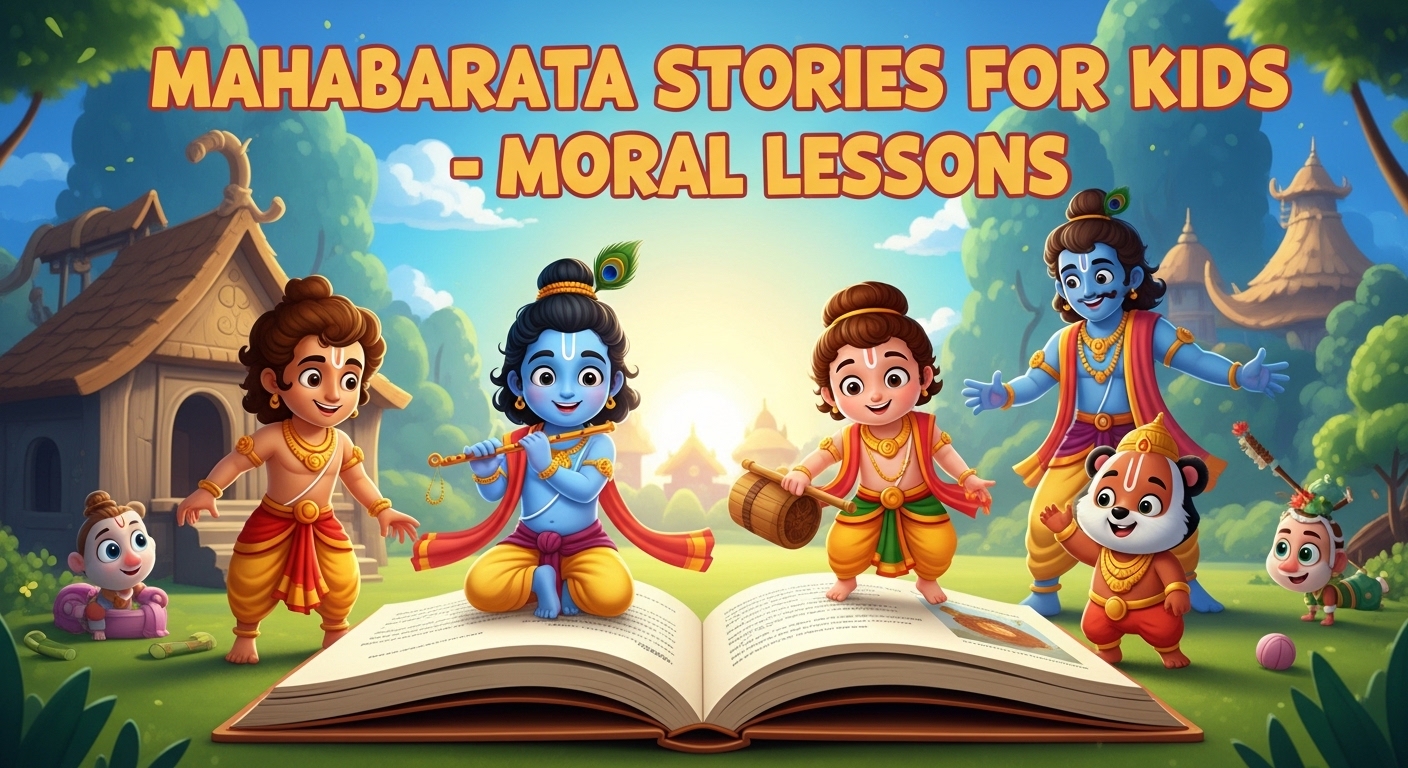
The Mahabharata is one of the greatest epics of India, filled with wisdom, values, and inspiring stories. For children, it is more than just a tale of kings, warriors, and battles—it is a guide that teaches the importance of honesty, kindness, courage, respect, and devotion. Through short stories from the Mahabharata, kids can learn valuable lessons that shape their character and guide them in life.
In this blog, we bring you some of the best Mahabharata stories for kids with moral lessons that will inspire young minds and make them understand the importance of virtues in everyday life.
The Story of Eklavya – A Lesson in Dedication
Eklavya, a boy from a tribal family, had a dream of becoming a great archer. He went to Guru Dronacharya, who was the royal teacher of the Kauravas and Pandavas. However, Drona refused to teach him because Eklavya was not a prince.
But Eklavya did not give up. He made a statue of Dronacharya and practiced archery with complete dedication in front of it. With time, he became an extraordinary archer, even better than Arjuna. When Dronacharya saw this, he asked for guru dakshina (a teacher’s fee). To protect Arjuna’s status, Drona demanded Eklavya’s right thumb. Eklavya, out of respect, immediately cut off his thumb and offered it without complaint.
Moral: Dedication, practice, and respect for teachers lead to greatness. This story also teaches sacrifice and humility.
Yudhishthira and the Value of Truth
Yudhishthira, the eldest of the Pandavas, was known as Dharmaraj, the follower of righteousness. He never lied and always believed in truth, no matter how difficult the situation was.
Once, during a game of dice, Yudhishthira lost everything—his kingdom, his brothers, and even his wife Draupadi—because he refused to go against his principles and cheat. Although he suffered, he proved that truth and dharma are more important than temporary victory.
Moral: Honesty is the foundation of strong character. The story teaches children to value truth over lies and integrity over selfish gains.
Arjuna and the Bird’s Eye – Focus and Concentration
One day, Guru Dronacharya wanted to test his students’ concentration. He placed a wooden bird on a tree and asked each student to aim at the bird’s eye. Before shooting, he asked them what they saw.
Some students said they saw the bird, the tree, or the branches. But Arjuna replied, “I see only the bird’s eye.” Because of his focus, Arjuna was the only one who succeeded in hitting the target.
Moral: Success comes with focus and concentration. This story teaches kids that distractions should be avoided when working toward a goal.
The Loyalty of Karna – Friendship and Generosity
Karna, the son of the Sun God, was abandoned at birth and raised by a humble charioteer’s family. Despite being insulted for his background, he became a mighty warrior.
Karna was a loyal friend of Duryodhana, who made him the king of Anga. Karna never left Duryodhana’s side, even when he knew that the Pandavas were following the path of truth.
Karna was also known for his generosity. He never said no to anyone who asked for help. Once, even when he was preparing for battle, he donated his armor and earrings to Indra, knowing it would make him vulnerable.
Moral: Loyalty and generosity are noble virtues. However, it also teaches that friendship should not blind us from choosing what is right.
Bhima and Hanuman – Strength with Humility
Bhima, one of the Pandavas, was known for his immense strength. Once, during his journey in the forest, he came across a monkey blocking his path with its tail. Bhima tried to move the tail but could not lift it despite his power.
The monkey revealed himself as Hanuman, Bhima’s elder brother (both were sons of the Wind God). Hanuman reminded Bhima that true strength comes with humility and respect.
Moral: Power should always be balanced with humility. Children learn that arrogance can weaken even the strongest person.
The Game of Dice – A Warning Against Greed
The Kauravas invited the Pandavas to a game of dice. The dice were loaded, and Yudhishthira lost everything—his kingdom, his brothers, and Draupadi. This led to great humiliation and the eventual war of Kurukshetra.
The story shows how greed and unfair practices can destroy families and kingdoms.
Moral: Greed and dishonesty always lead to downfall. The story warns kids to avoid unhealthy temptations and unfair means.
Draupadi’s Vow – Courage and Justice
When Draupadi was insulted in the court after Yudhishthira lost her in the game of dice, she prayed to Lord Krishna for help. Krishna protected her dignity by providing her with endless cloth when Dushasana tried to disrobe her.
Humiliated, Draupadi took a vow that she would not tie her hair until Dushasana was punished. This vow fueled the Pandavas’ determination during the Kurukshetra war.
Moral: Courage, self-respect, and seeking divine help in difficult times bring strength. It also shows that justice always wins in the end.
Abhimanyu’s Bravery – Sacrifice for Duty
Abhimanyu, the young son of Arjuna, was a brave warrior. During the Kurukshetra war, he entered the Chakravyuha formation of the Kauravas. Though he knew how to enter but not how to exit, he still fought with unmatched courage.
He defeated many warriors before being unfairly surrounded and killed. His sacrifice remains one of the most inspiring stories of the Mahabharata.
Moral: Bravery and sacrifice for duty are noble virtues. Kids learn that standing for the right cause is more important than personal safety.
Krishna’s Guidance – Dharma Above All
Lord Krishna played the role of guide and friend to the Pandavas. On the battlefield, when Arjuna refused to fight against his own relatives, Krishna gave him the wisdom of the Bhagavad Gita. He explained that one must perform their duty without attachment, and that righteousness should always guide actions.
Moral: Duty and righteousness should come before emotions. This story teaches children the value of responsibility and moral choices.
FAQs:
Why should kids read Mahabharata stories?
Kids learn honesty, courage, respect, and values through simple moral lessons.
Which Mahabharata story teaches focus?
Arjuna and the bird’s eye story teaches the importance of focus and concentration.
What lesson does Eklavya’s story give children?
It teaches dedication, respect for teachers, and sacrifice.
How does Bhima and Hanuman’s story inspire kids?
It shows that true strength is always balanced with humility.
Which Mahabharata story teaches about greed?
The game of dice teaches how greed and dishonesty lead to downfall.
Conclusion
The Mahabharata is not just a story of war—it is a collection of timeless values and morals that are still relevant today. For children, these stories provide simple yet powerful lessons on honesty, dedication, focus, humility, courage, and justice.
By learning from the lives of characters like Eklavya, Arjuna, Karna, Bhima, and Abhimanyu, kids can understand how virtues shape character and destiny. These moral lessons are stepping stones that help children grow into responsible, kind, and courageous individuals.